
You want a clean, handle-free kitchen, but you also want drawers that close quietly instead of banging shut. So which wins, soft close vs push to open? Good news: you don’t always have to choose. The catch is that the two mechanisms do opposite jobs, so how you combine them matters.
Whether you’re planning a handleless fit-out for a client or upgrading a builder-grade kitchen in a new home around Tarneit or Point Cook, here’s how it works.
The short answer on soft close vs push to open
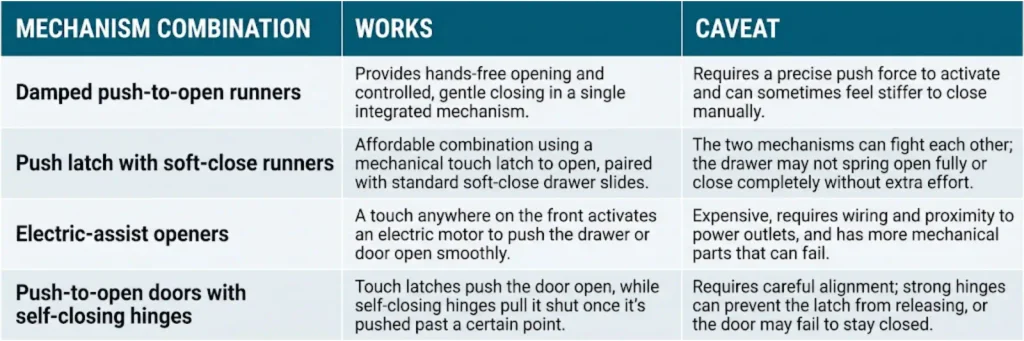
Yes, you can have both on one drawer. There are a few ways to get there:
- One mechanism that does both: a push-to-open runner that also slows the close.
- Two parts working together: a push latch fitted alongside a soft-close runner.
- Electric-assist openers: a powered option, if you want to go further.
The one caveat: the parts have to suit each other. Mix the wrong latch with the wrong runner and the drawer may not open or close the way you expect.
What soft close actually does
Soft close isn’t really about closing. It’s about slowing down. A damper takes over in the last stretch of travel and eases the drawer shut, so it doesn’t slam.
That means a soft-close drawer still needs something to open it, usually a handle, a knob or a finger pull. Have a look at our drawer runners and slides range for options, including:
What push to open actually does
Push to open does the opposite job. Press the drawer front and a spring-loaded mechanism releases it and pushes it out towards you. No handle needed, which is why it suits handle-free and handleless kitchen designs.
To close it, you push the drawer back in until the mechanism catches again. Browse our push to open mechanisms to see what’s available.
Path 1: one mechanism that does both
The simplest route is a push-to-open runner that also handles the close, so there is one product to fit and no separate latch to line up.
Two runners in our range to look at:
Not every push-to-open runner damps the close, so check the product details before you buy. If you’re not sure whether a runner does both, ask us and we’ll confirm before you order.
Path 2: push latch plus soft-close runners
The second route is to pair a separate push latch with a soft-close runner. This gives you more freedom to mix and match, but it’s where most of the confusion comes in.
The two parts work in opposite directions. The runner wants to ease the drawer closed, and the latch needs the drawer pushed in far enough to catch. If they don’t suit each other, the latch may not engage or release cleanly.
Before you buy:
- Check that the latch and runner are listed as compatible.
- Think about the weight of the drawer and what will go in it.
- If in doubt, bring the details to our Truganina trade counter or ask us before ordering.
Path 3: electric-assist openers
Electric-assist openers use a powered unit to open the drawer when it’s pressed. They’re a step up from mechanical options, and because they’re powered, you’ll need to plan for that during the fit-out rather than after it. If you’re interested, ask us about availability for your project before you finalise the cabinet design.
The doors problem: why doors are fussier than drawers
Doors and drawers behave differently, so don’t assume a solution that works on a drawer will work on a door.
On a door, you’re combining a push latch with the hinges rather than a runner. The same rule applies, as the parts have to suit each other, but you have more combinations to check. Before you commit to push to open on cabinet doors:
- Check the push latch suits the door size and the hinges you’re using.
- If your hinges are soft-close, confirm the latch will still engage.
- Fit one door first and test it before doing the whole kitchen.
If you’re upgrading a newer kitchen, our guide to the builder-grade upgrade order can help you decide what to change first.
Which path suits your project?
If you’re still weighing it up, start with what you already have and how the kitchen will be used:
- Starting from scratch and want the fewest parts? Path 1, as long as the runner you choose damps the close as well as opening.
- Already have soft-close runners and want to go handle-free? Path 2 can work, provided the latch suits your runners.
- Want a powered option? Path 3. Talk to us early, as it affects the design.
- Doing doors and drawers? Plan them separately. What works on one won’t automatically work on the other.
Before you order: a quick checklist
Run through these before you add anything to the cart:
- Measure each drawer and note what it will hold, so you can check the load rating.
- Match the runner length to the drawer depth.
- Check the product details for any gap the mechanism needs behind the drawer front.
- Decide where handles will and won’t go, so the kitchen looks consistent.
- Think about where people lean, especially around an island bench or near the sink.
- Plan to test one drawer or door before fitting out the rest.
FAQs
What are the disadvantages of each?
Push-to-open drawers can open when someone leans on or bumps them. Soft-close drawers still need a handle or pull, and they add to the cost of each drawer.
Is soft close worth it?
It adds to the cost per drawer, but if slamming drawers bother you, soft close deals with that every single day.
Are push-to-open drawers good?
They suit handle-free designs well. Think about where people stand and lean before you fit them, especially on an island bench.
Can push-to-open drawers open by accident?
Yes. They’re designed to open when pressed, so leaning against them can trigger them. Think about traffic lanes in your kitchen before fitting them.
Do heavy drawers need a different mechanism?
Heavier drawers want a stronger mechanism. Check the load rating on the product page before you buy.
Tips
- Doors and drawers behave differently, so don’t assume one solution covers both.
- Check the load rating before loading up a drawer with pots and pans.
- Test one drawer or door before fitting out the whole kitchen.
- Buying for several jobs? Our trade counter page explains how a trade account works.


