
A cabinet door that sags, rubs or will not stay shut is often down to a tired hinge. Replacing it is a simple job, but only once you know what you are replacing. There are more types of hinges than most people expect, and one that looks right on screen can turn out to have the wrong cup or overlay once it is in your hand.
You do not need to be a cabinet maker to work it out. Whether you’re fitting out a job for a client or fixing a kitchen door in a newer home around Tarneit or Point Cook, the checks are the same. Open the door, grab a tape measure, and run through these six in order:
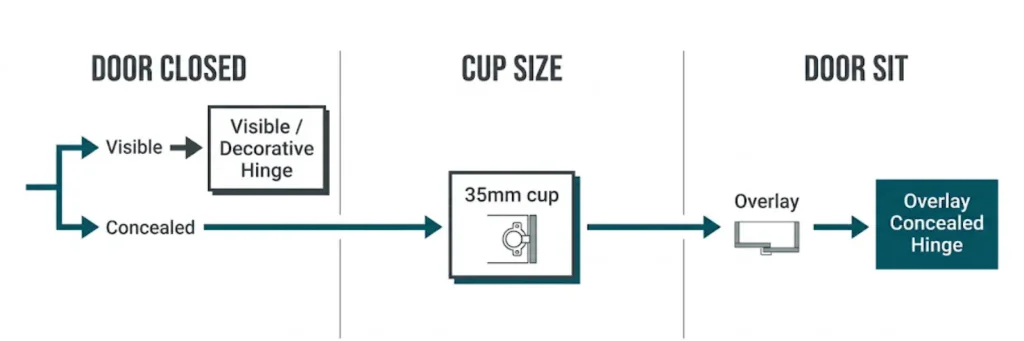
- Whether the hinge is visible with the door closed
- The cup size
- The screw holes and fixing
- The overlay
- The opening angle
- Matching your replacement
The quick check: what you can see with the door closed
Shut the door and look at the edge where it meets the cabinet.
If you can see metal, you have a visible hinge: a butt, flush or strap hinge. Head to the next section.
If you can’t see a thing, it’s concealed. That’s what you’ll find on most modern kitchen and laundry doors, and it’s where most of this guide spends its time.
Visible types of hinges: butt, flush and strap
These turn up on older cabinets, furniture and the odd feature door. They’re easy to tell apart once you know what to look for:
- Butt hinge. Two flat leaves joined by a pin. With the door shut, you can see the rounded knuckle in the gap.
- Flush hinge. Slimmer, with one leaf that folds inside the other, so it tucks into a tight gap.
- Strap hinge. The long one that runs across the face of the door. It’s usually there to be seen, on rustic or heavier doors.
When you replace one of these, match the screw holes. A new hinge that lines up with the old holes saves you filling and redrilling. Once you know the style, have a look through our full hinges category.
Concealed hinges: measure the cup, count the holes
Open the door and look inside. You’ll see a round cup sunk into the back of the door, and an arm reaching across to a plate screwed to the cabinet side. Between them, the cup, arm and plate tell you almost everything you need to know.
Measure the cup
Run a tape across the cup. If it reads 35mm, you’re in luck. That’s the standard size, and our standard concealed hinge is the obvious like-for-like.
Count the holes
Count the screws around the cup and on the plate, and note where they sit. Or just take a photo. If the new hinge matches the old holes, it goes straight back into the same spots.
Check the fixing
Two joins matter here:
- Cup to door. Is it held in with screws, or knocked in with pressed-in fixings?
- Arm to plate. Does the arm clip onto the plate, usually with a small lever to release it, or is it screwed on?
Clip-on is popular for a good reason: the door lifts off and goes back on without fuss. That’s handy when you’re painting, or when the plumber needs to get in under the sink. You can compare options in our concealed hinges range.
The overlay measurement that names full, half and inset
Get this one wrong and the new hinge won’t sit the door where you expect it. Overlay is simply how the door sits against the cabinet side:
- Full overlay. The door covers the front edge of the side panel.
- Half overlay. Two doors share one side panel, each covering part of it.
- Inset. The door sits inside the opening, flush with the front.
The quickest tell is the arm. A fairly straight arm usually means full overlay. The more it kinks (the trade calls this the crank), the more likely it’s half overlay or inset. Our overlay, half-overlay or inset guide goes into more detail.
Opening angles and special cases
Most doors are happy with a standard hinge. A few aren’t:
- Corner cabinets. A door that keeps knocking into its neighbour needs to swing wider. That’s what our 165-degree corner concealed hinge is for.
- Doors that need to open wider. If a standard hinge stops the door short of where you need it, a wider-opening hinge gives it more swing. Our Salice 155-degree hinge in black is one option.
- Glass doors. Glass needs a hinge made for the job, like our glass door concealed hinge, 110 degrees.
- Bi-fold doors. These work a little differently. Send us a photo and we’ll help you sort it out.
Not sure how far your door opens? Swing it right open and take a photo from above.
Choosing your replacement
By now you should have a cup size, a fixing type and an overlay. Here’s where they point:
- Swapping a standard 35mm hinge like-for-like? Go with the standard concealed hinge.
- Want soft close with a clip-on fitting? Look at the 4D soft-closing hinge with cross clip-on plate.
- Need the plate as well? The 3D concealed hinge with plate comes with one.
Each product page has the fit and adjustment details, so give them a read before you order. Weighing up different ranges? Our Hafele hinge comparison lays out the differences.
What to bring us for a match
Still not sure? Bring the old hinge into our trade counter in Truganina, or send us some photos. The more of these you have, the quicker we can find a match:
- The inside of the door, showing the cup and its screws
- The mounting plate on the cabinet side
- The arm, side-on, so we can see the bend
- The door closed, showing how it sits against the cabinet
- The door fully open
- The cup measurement and the door thickness
- Any numbers stamped on the hinge
If you buy for jobs regularly, it’s worth a look at our trade account benefits.
FAQs
What do the numbers stamped on my hinge mean?
They usually identify the hinge series, not the finish. Snap a photo of them anyway, because they’re a good starting point for a match.
Do I replace one hinge or all of them?
If one has failed and the rest are fine, you can often swap just that one. If the door is sagging, or the hinges don’t match each other, do the whole door so it hangs evenly.
Can I upgrade to soft close on the same plates?
Often, yes, as long as the new hinge suits your existing plate and drilling. You usually only need new plates as well when the drilling is different. Bring in the old plate or a photo and we’ll check.
How many soft-close hinges does a door need?
On a small door, one is often enough, with a standard hinge doing the rest. Heavier or taller doors may need them in pairs.
Tips
- Photograph everything before you undo a single screw. You’ll be glad of it when it’s time to put things back.
- Work on one door at a time, so the others stay put as a reference.
- Bring the old hinge, or a photo of the open cup, to the counter. It’s the fastest way to a match.
- Label each hinge with its door as you take it off, so nothing gets mixed up when they go back on.
- If several hinges in the kitchen are the same age, keep a spare on hand for the next one that wears out.


