
IKEA kitchens are everywhere in Australia. They are affordable, the box quality is decent, and the modular system makes planning straightforward. But the handle and knob options that come with them are limited, and plenty of people want something that feels a bit more substantial or suits a different style. The good news is that most IKEA cabinet hardware can be swapped out with standard handles and knobs from any supplier, as long as you get one measurement right.
This guide explains how to check whether your IKEA doors are pre-drilled, how to measure the hole centres, and what to do when you have doors with no holes at all. Everything here applies to IKEA kitchen cabinets, laundry units, and bathroom vanities sold in Australia.
The Short Answer
Yes, you can add handles or knobs to IKEA cabinets. Most IKEA door fronts sold in Australia come with pre-drilled holes at standard spacings. Any handle or knob with matching centre-to-centre (CTC) spacing will fit straight in, no drilling required.
The exception is a handful of ranges, like Knoxhult and some handle-less door styles, that ship without any pre-drilled holes. For those, you will need to drill your own holes or fit a knob, which only needs a single hole.
Why Most IKEA Doors Are Already Drilled for Handles
IKEA uses standardised hole spacings across most of its kitchen door ranges. The holes are typically drilled on the inside face of the door, covered by small plastic plugs or caps that pop out when you are ready to fit a handle.
The most common CTC spacings on IKEA kitchen fronts are:
- 128 mm: the standard spacing on most base cabinet doors and many wall cabinet doors
- 192 mm: used on wider drawer fronts and some taller doors
- Single hole: some doors are drilled for a single screw, designed for a knob rather than a bar pull
These spacings are not unique to IKEA. They are standard across the global cabinet hardware industry, which means any handle or cabinet knob built to the same CTC measurement will bolt straight on. You are not locked into buying handles from the same place you bought the kitchen.
Measuring the Hole Centres on Your Door or Drawer
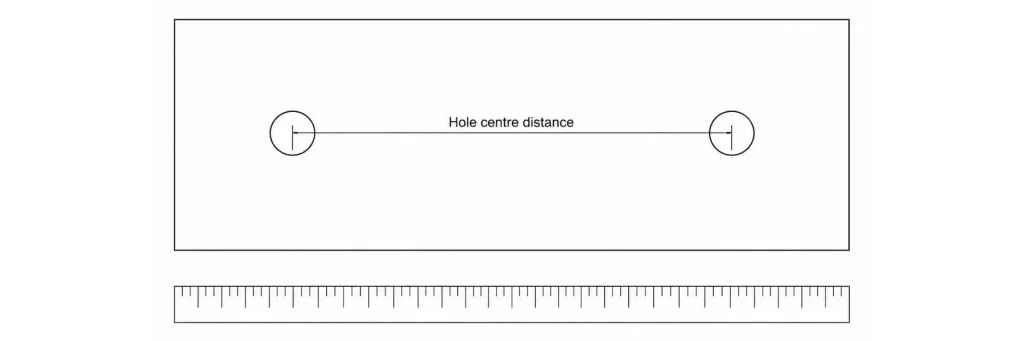
This is the step that determines whether a handle swap is a five-minute job or a more involved project. Get this measurement right and everything else is simple.
Here is how to measure CTC spacing:
- Remove any plastic plugs or caps covering the pre-drilled holes on the inside of the door
- Place the tip of your tape measure at the exact centre of the first hole
- Measure across to the exact centre of the second hole
- That distance, in millimetres, is your CTC spacing
A few practical tips:
- Measure in millimetres, not centimetres. Cabinet handles are listed in mm (96 mm, 128 mm, 160 mm, 192 mm), and rounding from centimetres can introduce errors.
- Measure more than one door. Most IKEA kitchens use the same spacing across all doors, but check a few to be sure, especially across different door sizes.
- Write the number down. It sounds obvious, but the most common mistake is measuring at home and then trying to remember the spacing at the hardware supplier.
For doors with a single pre-drilled hole, any standard cabinet knob will fit. Knobs use a single M4 screw through the centre of the hole, so the CTC question does not apply.
Choosing a Handle That Matches the Centres
Once you know your CTC spacing, choosing a handle is straightforward. Every cabinet handle is manufactured to a specific CTC, and reputable suppliers list it clearly on the product page.
For 96 mm CTC spacing: Some smaller IKEA doors and drawer fronts use 96 mm holes. Our HH 1092 square cabinet handle is a clean square profile in brushed nickel at 96 mm CTC that drops straight into those holes.
For 128 mm or wider CTC spacing: 128 mm is the most common spacing on IKEA kitchen fronts. Most bar handles, square profile handles, and D-handles are available in this size. Browse the full cabinet handles range to find options at 128 mm, 160 mm, and 192 mm CTC.
For single-hole doors: A cabinet knob is the natural choice. Knobs use one screw through one hole, so there is no CTC to match. The HH round cabinet knob 3801 series is a solid round knob in brushed nickel that suits both kitchen and bathroom IKEA cabinetry. Browse the full cabinet knobs range for other profiles and finishes.
What about handle screws? IKEA door fronts are typically 18 mm thick. Most cabinet handles ship with M4 screws in 25 mm length, which suits an 18 mm door with a few millimetres of engagement into the handle body. Check the screw length that comes with your chosen handle. Our handle screws are available in lengths from M4 x 20 mm through to M4 x 45 mm, so you can match the exact thickness of your door.
When There Are No Holes (Knoxhult and Handle-less Ranges)
Some IKEA ranges arrive with completely blank door fronts. Knoxhult is the most common example in Australia, and it is a popular choice for rental properties, granny flats, and budget renovations because the price point is low.
Handle-less IKEA fronts designed for integrated or push-to-open use also ship without holes, because they are not designed to take a visible handle at all.
For these doors, you have two options.
Option 1: Drill new holes yourself
- Mark the handle position using painter’s tape and a pencil. For a horizontal bar handle on a door, the standard placement is 40 to 50 mm from the top edge (on overhead doors) or 40 to 50 mm from the bottom edge (on base cabinet doors).
- Use a cabinet hardware drilling jig to ensure both holes are level and at the correct CTC spacing. Jigs are inexpensive and they prevent the single biggest cause of misaligned handles: drilling freehand.
- Drill from the front face of the door using a sharp 5 mm bit. Place a piece of painter’s tape over the drill point to reduce chipping on melamine and laminate surfaces.
- Drill slowly and do not push hard. Let the bit do the work. Melamine and laminate chip easily under pressure.
Option 2: Fit a knob instead
A knob only needs one hole, which halves the risk of misalignment. Mark the position, drill a single 5 mm hole, and screw the knob through from the inside. This is the safer option for anyone who is not confident drilling two perfectly spaced holes.
Drilling and Filling: The Honest DIY Trade-offs
Swapping handles on pre-drilled IKEA doors is genuinely simple. Drilling new holes into blank doors is a bigger commitment, and it is worth being honest about the trade-offs.
Drilling is worth it when:
- You want bar handles on a Knoxhult or handle-less range and you own (rather than rent) the property
- You have a drilling jig and a sharp bit, and you are comfortable with the process
- You are fitting the same handle across multiple doors and want a consistent look
Drilling is not worth it when:
- The doors are in a rental property and you need to return them to their original state
- You are not confident you can drill two level holes at the exact CTC spacing
- The door material is thin or already damaged, drilling adds stress to an already compromised panel
What about filling old holes? Occasionally people want to change from one CTC spacing to another, which means filling the old holes and drilling new ones. This is doable on timber and MDF doors using a two-part wood filler, sanded smooth and touched up with matching paint. On melamine and laminate surfaces, filled holes are harder to hide because the surface finish is a factory-applied layer that cannot be replicated with paint. The result is functional but rarely invisible.
For a deeper look at choosing the right handle style, finish, and profile before you commit to an order, our guide on what to know before you buy a single cabinet handle covers finish matching, sizing, and the mistakes Melbourne renovators make most often.
For the full hardware upgrade picture beyond just handles, including hinges, drawer runners, and the order to tackle each upgrade, our builder-grade kitchen upgrade guide walks through the process step by step.
FAQs and Tips
Can I use any brand of handle on IKEA cabinets?
Yes, as long as the CTC spacing matches the pre-drilled holes on your door. Cabinet hardware uses international standard spacings (96, 128, 160, 192 mm), so handles from any supplier will fit.
Do IKEA cabinet knobs use the same screw size as other brands?
Most IKEA knobs and handles use M4 screws, which is the industry standard for cabinet hardware across Australia and internationally. The screw length may differ depending on door thickness, but M4 is the standard thread.
What CTC spacing do most IKEA kitchens use?
128 mm is the most common CTC across IKEA kitchen door fronts sold in Australia. Some wider drawers use 192 mm. Always measure your specific doors to confirm, because the spacing can vary between ranges and door sizes.
Will changing handles void my IKEA kitchen warranty?
Swapping handles on pre-drilled doors does not alter the cabinet structure, so it should not affect the warranty on the cabinet boxes or frames. Drilling new holes into door fronts is a modification, and the standard IKEA warranty may not cover damage resulting from modifications. Check the specific warranty terms for your range.
Where should I position a handle on an IKEA door?
For overhead cabinet doors, the standard position is 40 to 50 mm from the bottom edge, centred horizontally. For base cabinet doors, 40 to 50 mm from the top edge. For drawers, centre the handle vertically and horizontally on the drawer front. Pre-drilled doors already have the position set for you.


