
Tall pantry cabinets look great on a floor plan. Plenty of height, a solid door, and the promise of proper kitchen storage. Then you move in, stack the shelves, and realise that the back third of every shelf has become a black hole. Tins go in, tins disappear. A pull out pantry changes that equation completely, because the whole unit slides toward you instead of making you reach into a dark cabinet with your arm at a bad angle.
This guide covers the practical side of choosing and fitting a pull out pantry system, especially for newer homes across Melbourne’s west and the surrounding growth areas where tall narrow pantry cabinets are standard in most kitchen layouts.
Why New Estate Pantries Become Dead Zones
Most new-build kitchens in Melbourne’s growth corridors come with a tall pantry cabinet. It is usually 600 mm wide, roughly 2,100 mm high, and fitted with three or four fixed melamine shelves. On paper, that is generous storage. In practice, a fixed-shelf pantry only gives you easy access to about two-thirds of each shelf, because your line of sight and your reach both stop well before the back wall of the cabinet.
The result is predictable:
- Items at the back get forgotten, pushed further in every time you add something new
- Heavy items like oil bottles and sauce jars sit on top shelves where they are awkward to grab
- You end up buying duplicates because you cannot see what you already have
- The bottom shelf becomes a catch-all, because nobody wants to crouch and reach 500 mm deep into a cabinet at floor level
This is not a design flaw in the house. It is a limitation of fixed shelving in a deep cabinet, and it applies to almost every project home kitchen built in Truganina, Tarneit, Point Cook and the wider Wyndham corridor over the past decade.
Pull Out Pantry vs Fixed Shelves: What Changes
A pull out pantry replaces fixed shelves with a wire or steel frame that mounts on heavy-duty runners inside the cabinet. When you open the door and pull the unit forward, every shelf slides out to full extension. You can see and reach every item from the front, including the bottom shelf, without crouching or guessing.
The practical differences:
- Full visibility. Nothing hides at the back. You see every jar, packet and tin the moment the unit extends.
- Better weight distribution. Pull out pantry shelves sit on runners rated for the load, so heavy items do not stress a single fixed shelf bracket.
- Less wasted height. Most pull out systems use more vertical tiers than a fixed-shelf layout, which means you use the full height of the cabinet instead of leaving large gaps between a few wide shelves.
- Easier cleaning. With the unit extended, wiping down shelves takes seconds instead of requiring a torch and a long arm.
Browse the full range of pull out pantries to see the different configurations available.
Widths That Fit a Standard Tall Cabinet
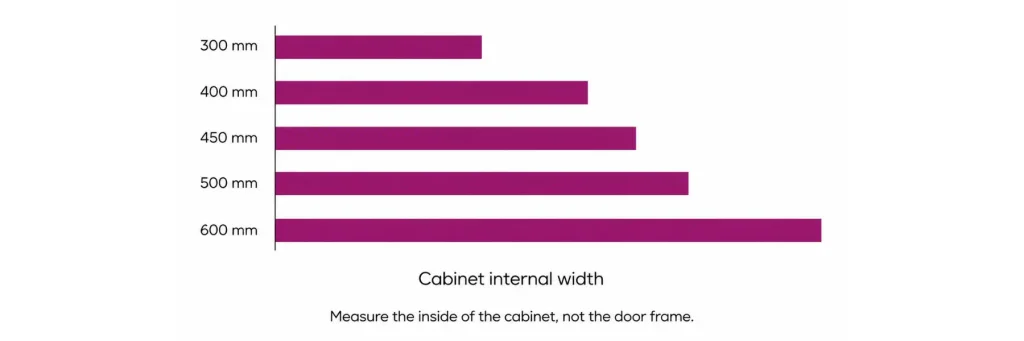
This is the question that matters most before you order anything. Pull out pantry units are sized to the internal width of your cabinet, not the door opening. Measure the inside of the cabinet, wall to wall, and match to the closest standard unit size.
Here is how the common widths line up:
- 300 mm: Fits narrow tall cabinets often found beside a fridge or oven tower. Good for spices, small jars and bottles in a single column.
- 400 mm: A common size for secondary pantry cabinets. Fits standard jars and tins side by side on each shelf.
- 450 mm: Slightly wider option that suits cabinets built to a 450 mm module, which is common in some builder specifications.
- 500 mm: The most popular size for a dedicated pantry in a new estate kitchen. Enough width for larger items like cereal boxes and oil bottles.
- 600 mm: Fits the standard 600 mm tall pantry cabinet that most volume builders install. This is the width you will see most often in homes across Melbourne’s west.
The rule is simple: measure the inside of the cabinet, not the door frame. A 600 mm cabinet with 16 mm side panels has an internal width of 568 mm, which is what your pull out unit needs to fit within. Standard units are designed with this clearance in mind, but always confirm internal dimensions before ordering.
Soft Close: The Mechanism That Makes a Heavy Unit Feel Right
A fully loaded pull out pantry cabinet can easily weigh 30 to 40 kg when stacked with tins, bottles and dry goods. Without a soft-close mechanism, that weight slams back into the cabinet every time you push it closed. It is loud, it wears the runners, and it feels rough in a space where everything else closes quietly.
Soft-close runners use a built-in damper that catches the unit in the last 30 to 50 mm of travel and draws it shut gently. The difference is significant on a tall, heavy unit like a pantry. It is also the feature that separates a quality pull out pantry from a budget one.
Our pull out pantry unit (soft closing) comes with the soft-close mechanism already integrated, so there is no need to source or fit a separate damper. It is available in chrome and white finishes to match your cabinet interior.
For a more premium setup with a tandem sliding system, where front and rear basket sections glide out together for full access, take a look at our tandem pantry unit. It uses a stainless steel and steel construction, and it covers widths suited to 600 mm through to 900 mm cabinets.
Retrofit into an Existing Cabinet vs Build into a New One
One of the most common questions we hear is whether a pull out pantry can go into a cabinet that already has fixed shelves. The answer is usually yes, as long as the carcass is sound.
Retrofitting into an existing cabinet:
- Remove the existing fixed shelves and any shelf pin strips
- Check that the cabinet sides, base and back panel are solid and level
- Measure the internal width, depth and height carefully
- The pull out unit mounts to the base of the cabinet and is secured with screws through the runner brackets into the side panels
- You will need a drill, a spirit level and about an hour for the install
- Existing door hinges stay in place; the pull out unit sits behind the door
Building into a new cabinet:
- Spec the pull out unit before the carcass is built, so the internal dimensions match exactly
- The cabinet maker can pre-drill mounting points and reinforce side panels where the runner brackets attach
- Soft-close units add a small amount of depth behind the rear basket, so factor that into your internal depth calculation
Retrofitting is a very popular upgrade for homes in Melbourne’s newer estates, where the cabinetry is only a few years old and the boxes are still in good condition. Our guide to builder-grade kitchen upgrades covers the full upgrade sequence, including how a pull out pantry fits into the priority order alongside hinges, handles and drawer runners.
What It Costs and What Drives the Price
Pull out pantry pricing varies based on three main factors: the type of system, the material, and whether it includes soft-close runners.
Here is a general framework:
- Single pull out pantry units (wire basket, soft close): these are the most accessible entry point and suit standard 450 to 600 mm cabinets
- Tandem pantry systems (dual-section pull out, stainless steel frame, soft close): these are a step up in build quality and functionality, designed for heavier daily use and wider cabinets
- Pull down pantry units (overhead systems for wall-mounted cabinets): a different product category, but worth mentioning because they solve a similar access problem for overhead cupboards
Our pull down pantry (soft closing) is worth a look for homeowners who also have deep overhead cabinets with hard-to-reach top shelves.
The biggest cost driver is the runner mechanism. A basic roller slide is cheaper but wears faster and does not include soft close. A ball bearing soft-close runner costs more upfront but lasts significantly longer under daily load, which is why we stock soft-close as the default across our pantry range.
For a full picture of what else you might need alongside a pantry system, our hardware supplies checklist covers hinges, runners, handles and all the fittings a kitchen project requires.
FAQs and Tips
Are pull out pantries worth it?
Yes. The access improvement alone justifies the cost for most kitchens. Instead of losing the back third of every shelf, you get full visibility and reach across the entire cabinet. Homeowners who cook regularly tend to notice the difference within the first week.
How wide should a pull out pantry be?
Match the unit width to the internal width of your cabinet. A standard 600 mm pantry cabinet takes a unit designed for that module. Always measure the inside of the cabinet, not the door opening, because the side panels reduce the usable width.
Can I fit a pull out pantry myself?
Most units are designed for DIY installation. You will need a drill, a spirit level and the ability to drive screws into melamine or timber side panels. The install typically takes 45 minutes to an hour for a single unit. For homes where the cabinetry is in good condition, it is one of the most practical kitchen storage upgrades you can do on a weekend.
What is the difference between a pull out pantry and a tandem pantry?
A standard pull out pantry uses a single frame that slides forward on runners. A tandem pantry has two sections, front and rear, that glide out together, giving you full access to a wider and deeper cabinet. Tandem systems are heavier-duty and better suited to larger kitchens with wider tall cabinets.
Do I need to remove my cabinet door to fit a pull out pantry?
No. The pull out unit sits inside the cabinet behind the existing door. You open the door normally, then pull the pantry unit forward on its runners. The door hinges and handle stay exactly as they are.
If you are also upgrading other parts of your kitchen hardware, our guide to kitchen storage for blind corners and dead pantries covers pull out baskets, corner units and under-sink organisers that work alongside a pantry upgrade.


