Most under cabinet lighting guides on the internet start and finish with stick-on battery pucks. Those might work in a rental, but if you are building or renovating a kitchen properly, they are not what a cabinetmaker or electrician would actually install. This guide covers the real thing: LED strip, aluminium profiles, proper drivers, and layouts that make a kitchen work harder after dark.
What Under Cabinet Lighting Actually Does
Kitchen under cabinet lighting is task lighting, not decoration. Its job is to throw an even wash of light onto the benchtop so you can see what you are chopping, measuring and cleaning. Ceiling downlights alone create shadows because your body blocks the light the moment you stand at the bench. A strip of LEDs mounted under the wall cabinets eliminates that shadow and lights the work surface directly.
It also happens to look great. But that is a bonus, not the reason a good kitchen includes it.
Strip, Profile, Puck or Bar: Where Each Belongs
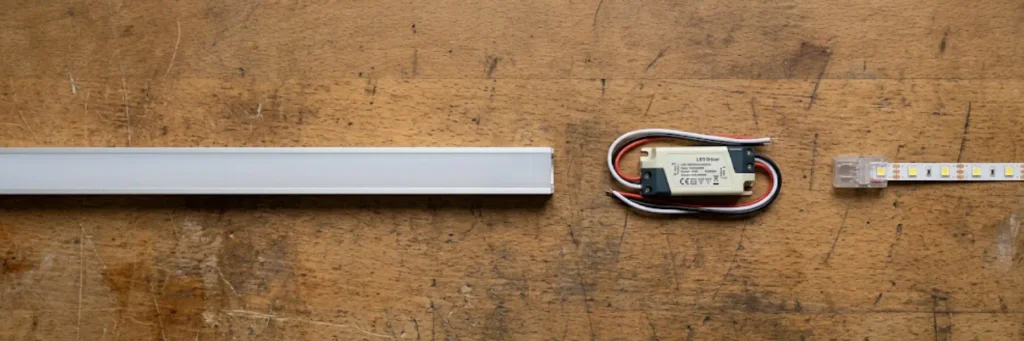
Not every under cabinet LED lighting option suits every situation. Here is a quick breakdown:
- LED strip light – the most versatile option. Runs in a continuous length, can be cut to size, and produces an even glow with no visible hotspots when paired with a diffuser profile. This is what most trade installers use for full-length cabinet runs. Hardware Heaven stocks the Hafele Loox5 COB LED strip at 24V, 480 LEDs per metre, which delivers smooth, dot-free illumination.
- Aluminium profile with diffuser – houses the LED strip, spreads the light evenly, protects the LEDs, and manages heat. An LED light profile with lip clips neatly to the underside of a cabinet and hides the strip completely.
- Puck lights – round, surface-mounted spots. They work for highlighting a single zone (inside a glass display cabinet, for instance) but create uneven pools of light across a long benchtop run.
- Light bars – self-contained units, easy to retrofit but limited to fixed lengths. Fine for a single section, less flexible than strip and profile.
For most new kitchen builds across Melbourne, the combination of LED strip plus aluminium profile is the standard trade approach.
Layouts That Work
You have two basic choices:
One continuous run along the full length of the wall cabinets. This is the cleanest look and the most practical. It lights every section of the bench evenly, and the single profile creates a tidy line when viewed from below.
Zoned lighting where you place separate strips above specific work areas: the sink, the main prep zone, the coffee corner. Zoned setups suit kitchens where wall cabinets do not run continuously or where you want independent switching for each area.
Either way, the goal is the same: consistent, shadow-free light on the surface where you actually work.
Mounting Position: The Front Third
Where you mount the strip under the cabinet matters more than most people realise. Place it too far back (near the wall) and the light hits the splashback instead of the bench. Place it dead centre and you still get some shadowing from the cabinet lip.
The sweet spot is the front third of the cabinet underside, right behind the face frame or door edge. At that position the light falls forward onto the benchtop, the cabinet lip hides the profile from view, and you get maximum coverage where your hands actually are.
Colour Temperature and CRI for Food Prep
Colour temperature is measured in Kelvin (K) and it determines how warm or cool the light looks:
- 2700K to 3000K – warm white. The most popular range for Australian kitchens. It complements timber cabinetry, stone benchtops and warm-toned interiors without making food look washed out.
- 4000K – neutral white. Better for clinical or commercial-style kitchens, but can feel cold in a standard home setting.
- 5000K and above – cool or daylight white. Rarely used in residential kitchens. Tends to make skin and food look blue.
CRI (Colour Rendering Index) is equally important. A CRI of 90 or above means colours look true under the light. For a kitchen where you are judging whether meat is cooked or vegetables are fresh, high CRI matters. The Hafele Loox5 COB strips stocked by Hardware Heaven deliver greater than 104 lumens per watt with excellent colour rendering.
Plug-in vs Hardwired: The Australian Wiring Reality
In Australia, any electrical work that involves fixed wiring must be carried out by a licensed electrician under AS/NZS 3000 (the Australian/New Zealand Wiring Rules). That means if you want your under cabinet LED lighting hardwired into a wall switch with no visible plug, an electrician needs to connect it.
The alternative is a plug-in setup. The LED driver plugs into a standard power point (often mounted inside the cabinet above), and the strip connects to the driver with low-voltage leads. This approach does not require an electrician for the low-voltage side, and it makes the system easy to replace or extend later. Many cabinetmakers across Melbourne’s growth corridors, from Truganina through to Werribee and Melton, use plug-in drivers as the default because it keeps the install simple and compliant.
Profiles, Drivers and Connectors: The Parts That Make It Look Built-in
A bare LED strip stuck to the underside of a cabinet works, but it does not look professional. Here is what turns it into a proper built-in result:
- Aluminium profile – the channel that the LED strip sits inside. A milky diffuser cover snaps over the top to spread the light and hide the individual LEDs. Browse the full range in Hardware Heaven’s LED Light Profiles category.
- LED driver – converts 240V mains power down to the 24V DC that the strip needs. The Hafele Loox5 constant voltage 24V driver (40W) is a compact unit that tucks inside a wall cabinet or in the void above a fridge. Pick a driver with enough wattage headroom to cover the total strip length.
- Leads, plugs and connectors – the bits that link the driver to the strip and the strip sections to each other. Hardware Heaven’s Lighting Systems category includes leads and plugs, extensions and sockets, and distributors for multi-run setups.
With kitchen renovations in Australia averaging $25,000 to $45,000 for a mid-range project (TradieVerify, February 2026), investing a few hundred dollars in proper under cabinet lighting makes a noticeable difference to the finished result.
Quick Room-by-Room Ideas
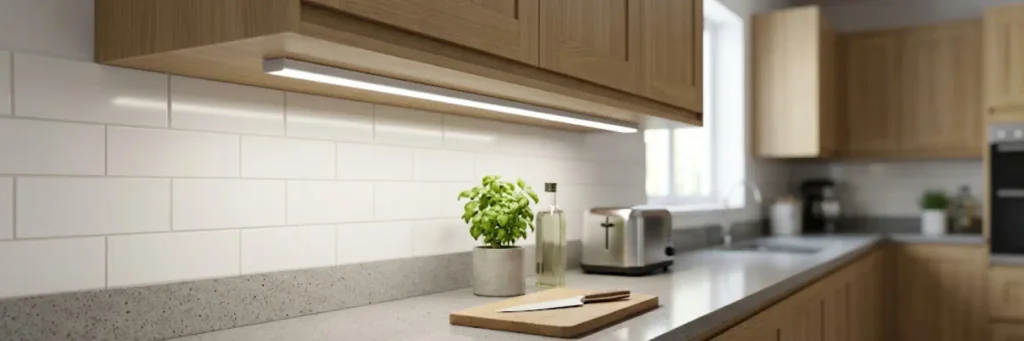
Under cabinet LED lighting is not just for kitchens. Here are a few other spots where the same strip-and-profile setup works well:
- Pantry – a short strip inside a pull-out pantry or on the underside of fixed shelves so you can actually read labels at the back.
- Laundry – mounted under the wall cabinets above the trough or folding bench. Same practical benefit as the kitchen: shadow-free task light.
- Study nook – a single profile under an overhead shelf or cabinet lights the desk without the glare of a desk lamp.
- Display cabinets – a warm white strip inside a glass-fronted cabinet adds depth without visible hardware.
If you are fitting out a full home and want to plan all your cabinet hardware in one go, our builder-grade kitchen upgrade guide covers the order of upgrades that makes the biggest impact for the least spend. And if you are starting a broader build, the hardware supplies checklist will help you avoid the mid-project scramble for parts.
Frequently Asked Questions
Do you need an electrician to install under cabinet LED lighting?
If you are hardwiring the system into a wall switch, yes. Australian wiring rules (AS/NZS 3000) require a licensed electrician for fixed wiring. A plug-in driver connected to an existing power point does not need an electrician for the low-voltage LED side.
Can you retrofit under cabinet lighting without rewiring?
Yes. A plug-in LED driver can sit inside the cabinet above and connect to the strip below with low-voltage leads. As long as there is a power point inside or behind the cabinet, no new wiring is needed.
What colour temperature is best for a kitchen?
Most Australian kitchens work best with warm white (2700K to 3000K). It complements timber, stone and warm interior palettes without distorting the appearance of food.
How do you hide the LED driver?
Mount it inside the wall cabinet above the benchtop, in the void space above the fridge, or in a nearby pantry. The driver only needs ventilation and access to a power point. Compact 24V drivers like the Hafele Loox5 40W unit are slim enough to sit on top of a cabinet shelf without taking up usable storage.