
Drawer slides vs drawer runners. Two names that show up everywhere when you are shopping for drawer hardware, and nobody seems to agree on which one means what. One product listing says “slides,” the next says “runners,” and a third uses both words in the same description.
The short version is that they are closely related, but they are not identical terms. Knowing the difference saves you from ordering the wrong thing and, more importantly, helps you read a spec sheet without second-guessing yourself. This guide walks through what each term actually refers to, the main types you will come across, and how to pick the right option for your project.
The Short Answer
A drawer slide is the moving mechanism itself, the telescopic carriage that uses ball bearings or rollers to let your drawer glide in and out. A drawer runner is the broader term for the entire system: the track that screws to the cabinet, the mount, and the slide mechanism together.
In everyday use across the Australian trade, both terms often refer to the same product. When you walk into a hardware supplier and ask for either one, you will usually be shown the same shelf. But on a spec sheet or product listing, the distinction can matter. A listing for a “runner” typically includes everything you need to install, while a listing for a “slide” may refer to just the moving component.
Browse our full range of drawer runners and slides to see how they are listed in practice.
What a Drawer Slide Actually Is
A drawer slide is the mechanism that does the work. It is the part that moves, and it comes in two main types.
Ball bearing drawer slides use rows of small steel balls held in a retainer cage. The balls roll between two or three telescopic steel channels, creating smooth, quiet movement with very little friction. Most quality kitchen drawer slides today are ball bearing, because they handle heavier loads and last longer under daily use.
Roller slides use small plastic or nylon wheels instead of ball bearings. They are lighter, simpler, and cheaper. You will find them in budget flat-pack furniture, office filing cabinets, and light-duty storage. They work fine for drawers that carry a few kilograms, but they are not built for a pot-and-pan drawer that gets pulled open ten times a day.
The key thing to understand: the slide is the moving part. Whether it uses ball bearings or rollers, it is the component that allows the drawer to extend and retract.
What a Drawer Runner Is (The Broader Term)
A drawer runner refers to the complete assembly. That includes:
- The cabinet member (the part that screws to the inside of the cabinet carcass)
- The intermediate member (the middle telescopic section, found in full-extension designs)
- The drawer member (the part that attaches to the drawer box itself)
- Any integrated soft-close or push-to-open mechanisms
When you order a pair of drawer runners, you are ordering everything needed to mount one drawer. That is why product listings from brands like Hafele tend to use the word “runner” in their packaging, because you are getting the full kit.
For a practical example, our soft close ball bearing runners (PHS) ship as a complete pair with all mounting hardware included, ready to install as either side mount or bottom mount.
Side Mount vs Undermount: The Two Ways They Fit
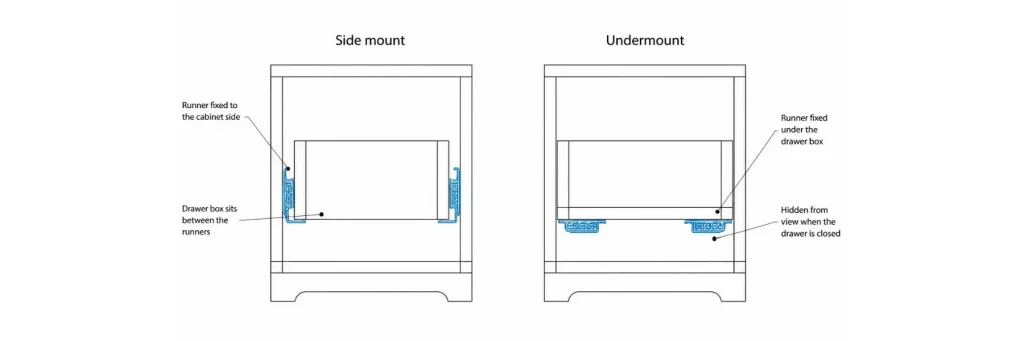
This is where the real decision sits for most people. Whether you call them slides or runners, the hardware mounts in one of two ways.
Side mount runners attach to the inside walls of the cabinet on both sides. The drawer box sits between the two runners, and the slides are visible when the drawer is open. Side mount is the most common setup in Australia for standard kitchen and bathroom cabinets. It is straightforward to install, forgiving of small measurement errors, and easy to replace. If you are doing a DIY kitchen upgrade, side mount is almost certainly what you want.
Undermount drawer slides fix underneath the drawer box, hidden from view. When you open the drawer, you see clean timber or melamine sides with no visible hardware. Undermount systems require more precise drilling and a drawer box built to tighter tolerances, which is why they are more commonly specified by professional cabinet makers and joiners.
The trade-off is simple: side mount is easier to fit and more practical for most projects. Undermount looks cleaner but demands more skill and a drawer box built to exact specs. Both types are available with soft-close and full-extension features.
Which One Belongs in a Kitchen Drawer
Kitchen drawers take more punishment than almost any other piece of furniture hardware in a home. According to the HIA Kitchens and Bathrooms Report (2025), the national median spend on a mid-range kitchen renovation sits around $35,000, with cabinetry accounting for 30 to 45 per cent of the total budget (source: What’s The Damage, April 2026). At that level of investment, the hardware inside your drawers is not the place to cut corners.
For kitchen use, we recommend:
- Ball bearing slides over roller slides, for load capacity and longevity
- Soft close drawer runners, because nobody wants a slamming cutlery drawer at 6 AM
- Full extension, so you can reach items at the back without blindly fishing around
- A minimum 35 kg load rating per pair for general kitchen drawers, and 45 kg or higher for pot-and-pan drawers
Our soft close ball bearing runners (Hafele) are rated to 45 kg and are a popular choice among Melbourne cabinet makers for exactly this reason. If you are after a more budget-friendly option with the same soft-close action, the PHS range covers lengths from 300 mm to 550 mm.
If you are also fitting out internal storage like pull-out pantries or blind corner baskets, take a look at our kitchen and living solutions range, those systems come with their own integrated runners.
Load Ratings and Soft Close: What the Numbers Actually Mean
When you look at a product listing for drawer slides, you will see two numbers that matter most.
Load rating (in kilograms per pair) tells you the maximum weight the runners can support when the drawer is fully extended. Here is a practical guide:
- 25 kg per pair: fine for bathroom vanity drawers, bedside tables, office drawers
- 35 kg per pair: suitable for most standard kitchen drawers (cutlery, utensils, dry goods)
- 45 kg per pair: the sweet spot for heavier kitchen drawers, pot-and-pan drawers, and workshop storage
- 70 kg+ per pair: commercial and industrial applications, deep file drawers, heavy tool storage
Soft close means the drawer has a built-in damper that catches it in the last 30 to 50 mm of travel and pulls it shut gently. No slamming, no noise. Soft close has become the standard for kitchen cabinetry across Australia, and it adds very little to the overall project cost.
If you want handleless cabinetry, you will need push-to-open ball bearing runners instead, which use a spring mechanism to pop the drawer open with a light press.
A Plain-Language Decision Table: Trade vs DIY
| Question | Trade / Professional | DIY / Weekend Project |
| Side mount or undermount? | Undermount for premium kitchens, side mount for standard builds | Side mount, unless you have the jig and the patience for undermount |
| Ball bearing or roller? | Always ball bearing for kitchens and wardrobes | Ball bearing for anything that gets daily use; roller is fine for light storage |
| Soft close? | Yes, standard on every kitchen job | Yes, worth the small extra cost on any drawer you open daily |
| What load rating? | Match to application: 35 kg minimum kitchen, 45 kg for pan drawers | 35 kg covers most home projects |
| What length to order? | Measure cabinet depth, subtract 10 to 20 mm | Same rule, and double-check before ordering |
| Full extension or partial? | Full extension for kitchens and pantries | Full extension if budget allows; partial is adequate for furniture |
If you are planning a full kitchen build, our hardware supplies checklist covers everything from hinges and handles to edge banding and fasteners. It is worth running through before you start ordering.
For drawer box systems with integrated runners already built in, take a look at our Hafele Matrix Box and PHS Premium Draws ranges.
FAQs and Tips
Are drawer slides and drawer runners the same thing?
In most practical situations, yes. “Drawer slide” tends to refer to the moving mechanism, while “drawer runner” covers the whole assembly. When you are ordering, the terms are used interchangeably by most Australian suppliers. Just check the listing to confirm you are getting a complete pair.
Can I replace roller slides with ball bearing runners?
Usually, yes. Ball bearing runners use the same mounting positions as most roller slides. Measure your existing runners (length and mounting holes) and you should find a direct replacement. This is one of the simplest kitchen upgrades you can do, the difference in drawer feel is immediate.
How do I know what length drawer runner to order?
Measure the internal depth of your cabinet from the front edge to the back panel. Subtract 10 to 20 mm. That is your runner length. Standard sizes in Australia are 300 mm, 350 mm, 400 mm, 450 mm, and 500 mm.
Do soft close runners need special installation?
No. Soft close ball bearing runners install the same way as standard ones. The damper is built into the runner itself, so there are no extra parts or adjustments. If you can drill a straight line, you can fit soft close runners.
What other hardware do I need for a drawer project?
Beyond runners, you will need the drawer box itself (timber or metal), chipboard screws for mounting, and a handle or knob for the drawer front. If you are building from scratch, review our guide to choosing the right cabinet hinge overlay for the doors, and our one-stop cabinet supplies guide for everything else on the list.


